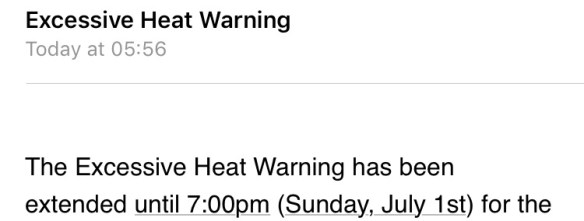
When there is an official excessive heat warning issued for the area and countless events are canceled in your jurisdiction – do you double check your scheduled unmonitored promoted snarky social media posts to ensure it parallels official safety warnings and safe guidelines for life sustainment?
Yeah, not the best decision because it was dangerously hot here today.
Make sure your peeps are safe, cool, and hydrated.
Let’s discuss this…because this news station/reporter could have made better decisions.
Soooooooo let’s use this as a good teaching moment. We Public Affairs pros are out there every day with the news media. Let’s revisit a few media relationships.
Perhaps in this situation, the news media was a askew on the important items and failed to think about the victim. I wish they would have considered the victim’s position. And if you heard the reporter say, “for the record” – the news story is NOT the record.
And yes, we as PIOs understand the mantra of following orders….TRUST ME we do. But taking the time to call, text, DM, etc….might be a good check between the PIO and media partners.
PIOs should reinforce to media that aside from going out to the scene, calling the PIO or the PAO might be a good option first. Most PIOs will tell you honestly if it’s a decent story or not. So establish trusted relationships before an emergency or disaster.
To my fellow PIOs – revisit your media relationships again. Wish them a happy summer and tell them to “be safe and do the right thing” – for realz.
Remember, the news media is our partner in proliferating information out during an emergency so as professionals, we should all work more closely together and use this as a PIO/media relations teaching moment.
Kudos to Newburgh Heights Police Department (located in NE Ohio).
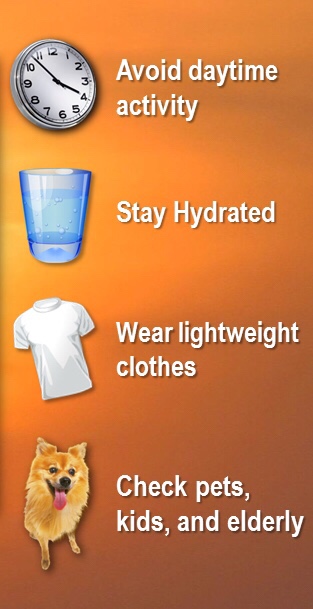
Slow down: reduce, eliminate or reschedule strenuous activities until the coolest time of the day. Children, seniors and anyone with health problems should stay in the coolest available place, not necessarily indoors.
Dress for summer. Wear lightweight, loose fitting, light-colored clothing to reflect heat and sunlight.
Eat light, cool, easy-to-digest foods such as fruit or salads. If you pack food, put it in a cooler or carry an ice pack. Don’t leave it sitting in the sun. Meats and dairy products can spoil quickly in hot weather.
Drink plenty of water (not very cold), non-alcoholic and decaffeinated fluids, even if you don’t feel thirsty. If you on a fluid restrictive diet or have a problem with fluid retention, consult a physician before increasing consumption of fluids.
Use air conditioners or spend time in air-conditioned locations such as malls and libraries.
Use portable electric fans to exhaust hot air from rooms or draw in cooler air.
Do not direct the flow of portable electric fans toward yourself when room temperature is hotter than 90°F. The dry blowing air will dehydrate you faster, endangering your health.
Minimize direct exposure to the sun. Sunburn reduces your body’s ability to dissipate heat.
Take a cool bath or shower.
Do not take salt tablets unless specified by a physician.
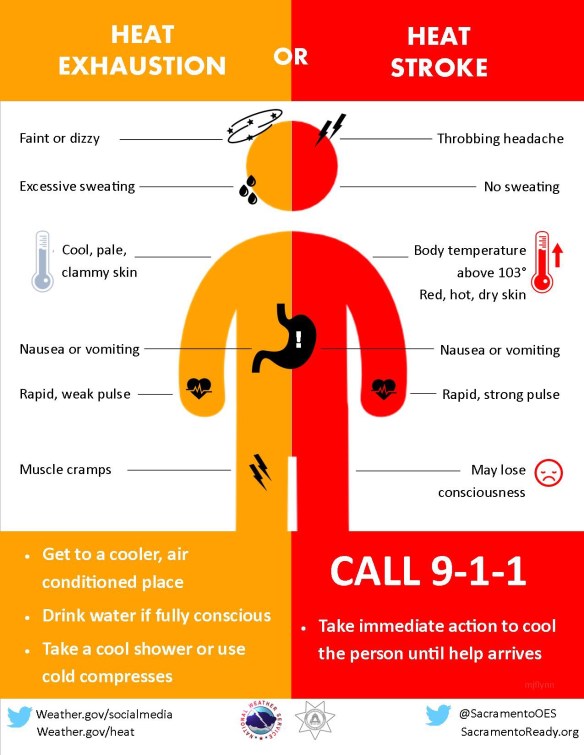
Check on older, sick, or frail people who may need help responding to the heat. Each year, dozens of children and untold numbers of pets left in parked vehicles die from hyperthermia. Keep your children, disabled adults, and pets safe during tumultuous heat waves.
Don’t leave valuable electronic equipment, such as cell phones and gps units, sitting in hot cars.
Make sure rooms are well vented if you are using volatile chemicals.
And of course: WEAR SUNSCREEN!!!!
Don’t get burned this summer….(<–see what I did there?!?)
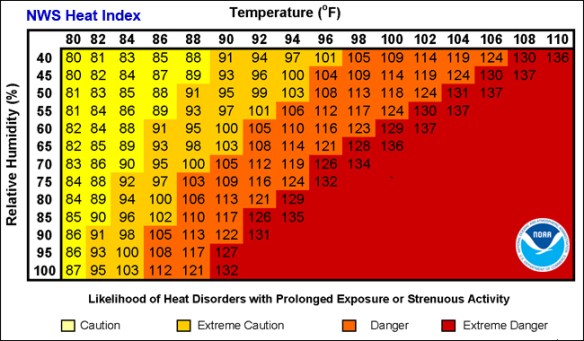
The Heat Index is a measure of how hot it really feels when relative humidity is factored in with the actual air temperature. To find the Heat Index temperature, look at the Heat Index Chart above or check our Heat Index Calculator. As an example, if the air temperature is 96°F and the relative humidity is 65%, the heat index–how hot it feels–is 121°F. The red area without numbers indicates extreme danger. The National Weather Service will initiate alert procedures when the Heat Index is expected to exceed 105°-110°F (depending on local climate) for at least 2 consecutive days.
NWS also offers a Heat Index chart for area with high heat but low relative humidity. Since heat index values were devised for shady, light wind conditions, exposure to full sunshine can increase heat index values by up to 15°F. Also, strong winds, particularly with very hot, dry air, can be extremely hazardous.
Information provided by the NWS – the official source of weather related information.
Lots of discussion was sparked by spontaneous volunteers.
While easy to handle, complex to handle without a tested and easy system to categories skills and personnel.
Additionally, lots focused on resource and supplies. A casual remark in class is that volunteers can house all kinds of stuff and be able to distribute everything accordingly.
Let me be very honest, I love people that want to help. But if you dump this task on an untrained and unfamiliar set of volunteers, it will not go smoothly. You have to train them, set them in a direction, and of course be as organized and coordinated as you can be. Make them part of your team EARLY!
So to share a perfect example of serving in disaster recovery, I’ll again share the AmeriCorps package we put together while deployed out for Hurricane Maria on the US Virgin Islands St. Thomas.
Outstanding crew to work with and solid bunch of dedicated individuals to the mission at hand. More info about AmeriCorps, click here and AmeriCorp Blue-6 (<—That team is SOLID).
A few takeaways for participants in today’s class:
Build relationships before an emergency.
Enhance capabilities and knowledge.
Evaluate skill sets of your volunteer workforce.
Exercise, Exercise, Exercise.
Help your neighbor.
Do good stuff.
Train your volunteers frequently as they should be a valuable part of our community’s recovery process.






 Where is @rusnivek?