@rusnivek’s Top-6 Public Safety / PIO social media tips…for free

I had a thought this AM..I need to provide you more public safety social media tips. And since you only have 30 seconds to spare, maybe less, I’ll keep it very short.

SO, here’s part-1 of my top 6 SM tips for public safety professionals / Public Information Officers (PIOs). And yes, it’s free for you.

@rusnivek Social Media Tip-1: Post it first (because they don’t interview the runner-up).

If you don’t post it first, someone else will be first to tell your story.

And that’s going to suck…because only you tell your story the best.

It only takes a few minutes to tell your story. 

It takes a TON of money and time to fix the wrong story, and then to tell it right.

To put things in perspective, “There are no points for second place.”

425_topgun_cruise_tom_lc_042710

Tip-1: Post it first (because they don’t interview the runner-up).

@rusnivek
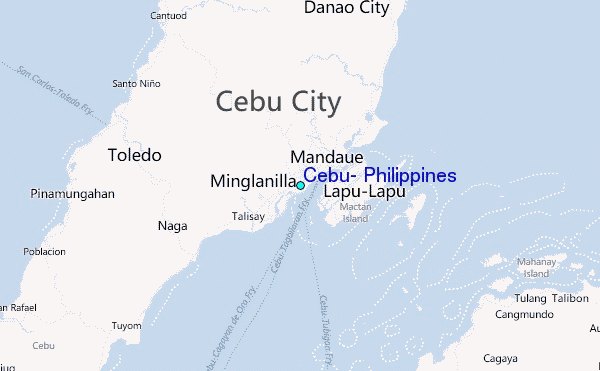
7.2 Earthquake in Philippines – here’s some free tips to stay safe after an earthquake #Cebu #Mindanao #Boljoon #Bohol

For those in and around the Philippines, take caution in all activities.

Cebu-Philippines_10

Here are some tips that you can use as you recover from your large earthquake.

  • When the shaking stops, look around to make sure it is safe to move. Then exit the building.
  • Expect aftershocks. These secondary shockwaves are usually less violent than the main quake but can be strong enough to do additional damage to weakened structures and can occur in the first hours, days, weeks, or even months after the quake.
  • Help injured or trapped persons. Remember to help your neighbors who may require special assistance such as infants, the elderly and people with access and functional needs. Give first aid where appropriate. Do not move seriously injured persons unless they are in immediate danger of further injury. Call for help.
  • Look for and extinguish small fires. Fire is the most common hazard after an earthquake.
  • Listen to a battery-operated radio or television for the latest emergency information.
  • Be aware of possible tsunamis if you live in coastal areas. These are also known as seismic sea waves (mistakenly called “tidal waves”). When local authorities issue a tsunami warning, assume that a series of dangerous waves is on the way. Stay away from the beach.
  • Use the telephone only for emergency calls.
  • Go to a designated public shelter if your home had been damaged and is no longer safe.
  • Stay away from damaged areas. Stay away unless your assistance has been specifically requested by police, fire, or relief organizations. Return home only when authorities say it is safe.
  • Be careful when driving after an earthquake and anticipate traffic light outages.
  • After it is determined that its’ safe to return, your safety should be your primary priority as you begin clean up and recovery.
  • Open cabinets cautiously. Beware of objects that can fall off shelves.
  • Put on long pants, a long-sleeved shirt, sturdy shoes and work gloves to protect against injury from broken objects.
  • Clean up spilled medicines, bleaches, gasoline or other flammable liquids immediately. Leave the area if you smell gas or fumes from other chemicals.
  • Inspect the entire length of chimneys for damage. Unnoticed damage could lead to a fire.
  • Check for gas leaks. If you smell gas or hear blowing or hissing noise, open a window and quickly leave the building. Turn off the gas at the outside main valve if you can and call the gas company from a neighbor’s home. If you turn off the gas for any reason, it must be turned back on by a professional.
  • Look for electrical system damage. If you see sparks or broken or frayed wires, or if you smell hot insulation, turn off the electricity at the main fuse box or circuit breaker. If you have to step in water to get to the fuse box or circuit breaker, call an electrician first for advice.
  • Check for sewage and water lines damage. If you suspect sewage lines are damaged, avoid using the toilets and call a plumber. If water pipes are damaged, contact the water company and avoid using water from the tap. You can obtain safe water by melting ice cubes.

For more up to the minute information, consider following @philredcross for more details.

Stay safe everyone.

@rusnivek

Your crisis response plan should not include spray paint #PIO

Thai Airways had a front landing gear failure upon landing at Bangkok.

As part of their crisis plan, they spray painted/blacked out their company logo from the aircraft.

Ahem…despite your vehicles, apparatus, aircraft, etc….getting into an accident, do not try to spray paint your logo off the rigs.

Here to help illustrate the point, check this short video out.

Kudos to those crazy Taiwanese animation folks.

@rusnivek

@flatstanley visits the Joint Information Center (JIC) #NATLPREP

Having a little #NATLPREP fun w/ @flatstanley here at the Joint Information Center (JIC). Be Informed #PIO — with Erica Creech.

1053507_372154769554034_1038387077_o

Because everyone participates in National Preparedness Month.

@rusnivek