Welcome to 2014 National Preparedness Month #NatlPrep #Prepared2014

Welcome to 2014 National Preparedness Month.
IMG_4934


Throughout this month, I’ll be pushing preparedness stuff…for free!

Best news on Monday huh?

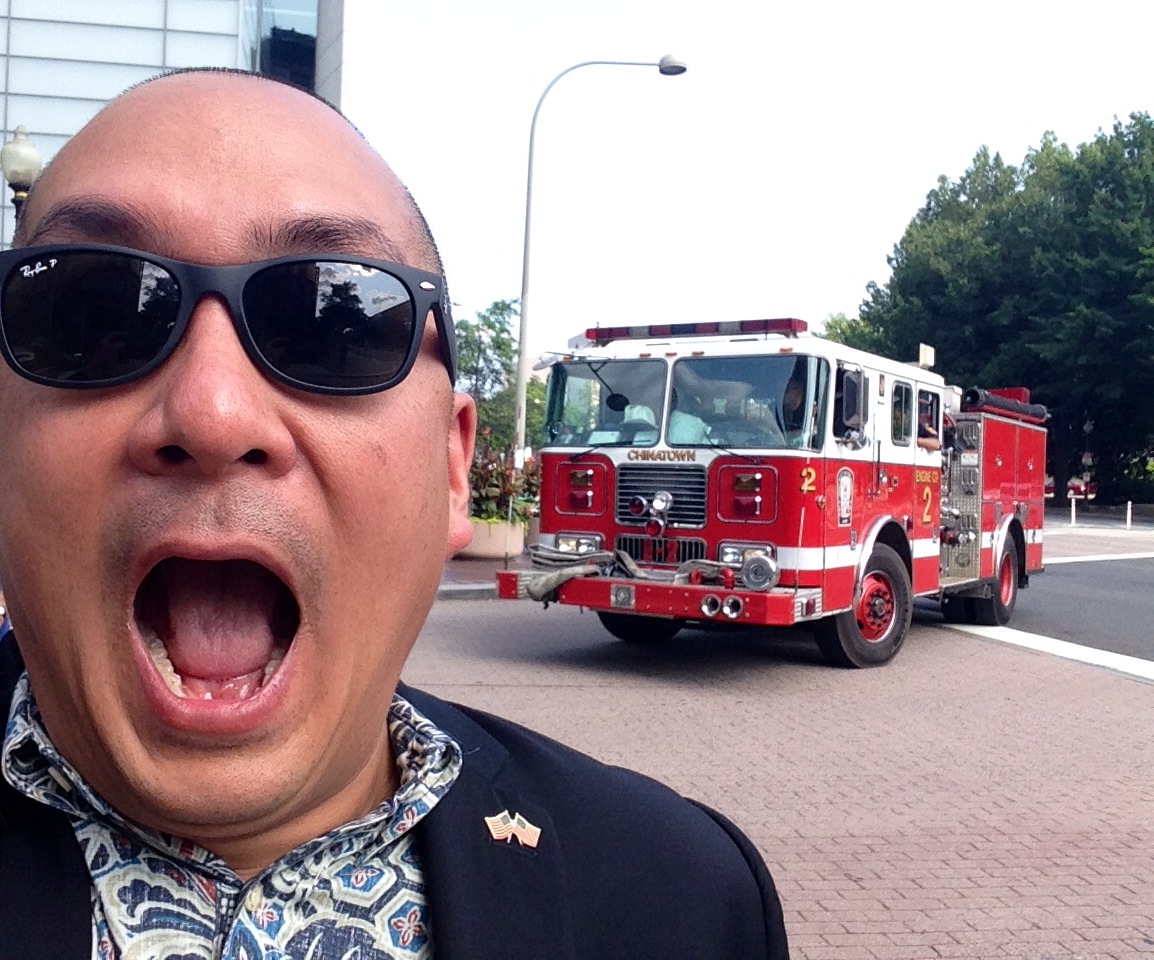
#1: Allow ample room for all emergency services to do their job

@rusnivek

September assignments to R5 & R3 – Also #NatlPrep #Prepared2014

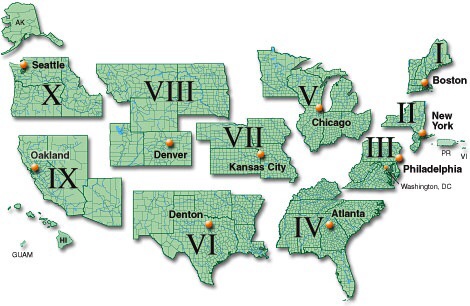
After hopping around Region V in August, I’ll be able to stretch out a bit and swing east into Region-3. The September intel training class in DC will be rescheduled and (hoping that it’ll) get moved to the Pentagon.

At this time, it is Pennsylvania, Maryland, and back in Ohio for September.
20140501-083012.jpg

The outlook for October has a wider spread as I have been assigned to Region-V, Region-IV, and Region-III.

Keep smiling because it’s 2014 National Preparedness Month! (MY FAVORITE MONTH)

@rusnivek

Wednesday meetings at FEMA #SURINDC

As usual, I always make it a point to stop by FEMA HQ to meet with a few friends and teams working the FEMA magic.

IMG_4887

First stop was to see the crew leading the Ready Campaign. Lots to discuss including the measure of preparedness and how we can more heavily promote preparedness digitally within each community. We constantly need to access our information that we are pushing and additionally make sure that the information is specific and actionable…esp during a disaster.

The general public seeks solid information FROM MOBILE DEVICES during an emergency. We cannot convolute the message, it must be clear and concise.photo

Did you know FEMA’s Ready.Gov program was featured at the White House Innovation for Disaster Response Recovery Event on Tuesday during the presentation by Appallicious? Check out the event and pictures here.

IMG_4763

Mobile platforms must be easy to navigate and less cluttered. Almost everything is read on mobile platforms right? Duh! Esp since you can’t take/turn on your desktop computer while you are evacuating to an emergency.

Between meetings, I usually find a moment to take a funny picture with the hard-working FEMA pro, my friend Jana. She. Is. Hilarious.

IMG_4892

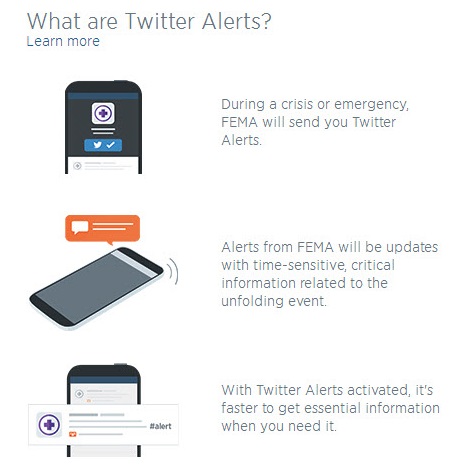
Short meeting with the Digital Team at FEMA to discuss social media efforts and promoting great programs like FEMA’s SocialHub and Twitter Alerts.

twitter_fema_alerts- twitter_fema_alerts-a - Copy

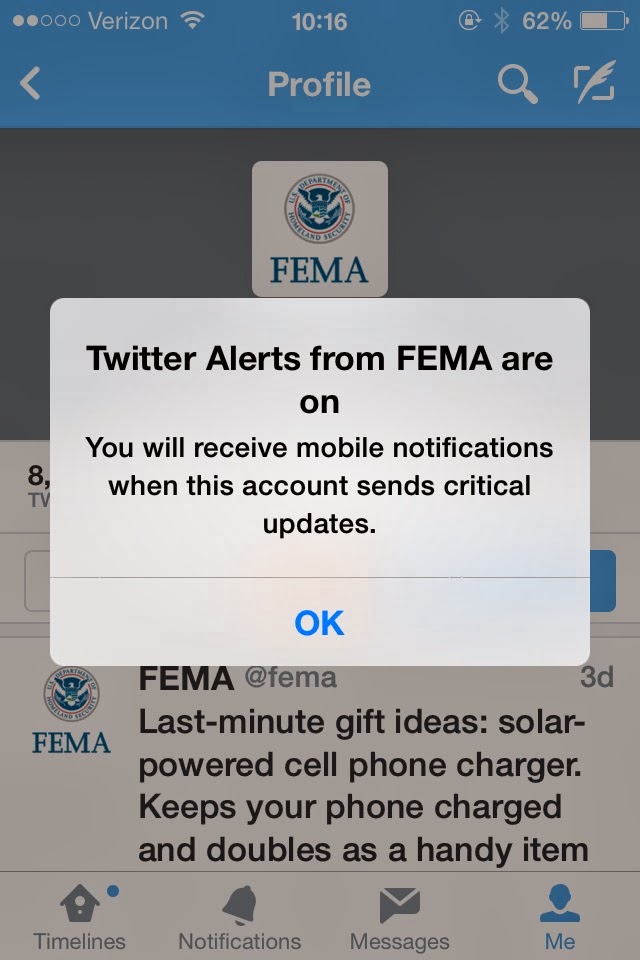
But seriously, make sure you turn on your Twitter Alerts to get pertinent messaging from FEMA. It can be done from your mobile phone and it takes seconds to do.
Twitter Alert 2

In the coming months, we will be exploring a few classes that we can help cross promote a few programs. And I hope I get chosen to teach the class at FEMA HQ.
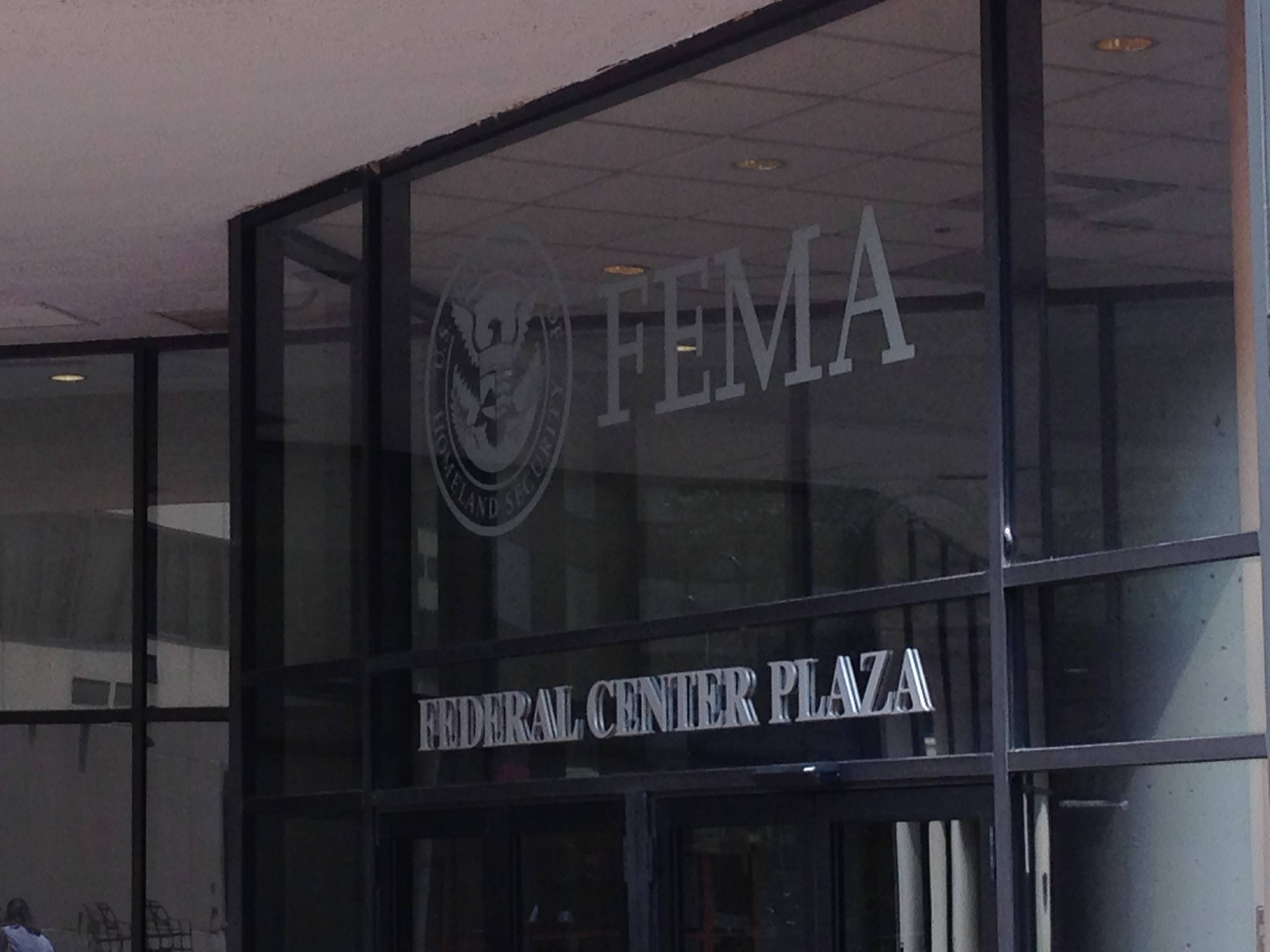
IMG_4895

End of the day was spent chilling in the Executive Administration side of the house. And of course trying to catch a few moments with Craig.

IMG_4938

Whew…what a day!

@rusnivek

SM as tool for intel for a few Federal programs

Great meeting this afternoon with the leadership at the Department of Homeland Security Bi0Watch program today in the DC area.

blog-keyboard-bannerl

I look forward to having more interaction for the conference calls, national conferences, and closed-door workshops showcasing the use of social media as one facet of on intelligence gathering and preparedness information dissemination.

Looking forward to seeing some of you folks later this year!

dhs_logo

Special mahalos to Monique for intros.

@rusnivek

Free tips: When Thunder Roars, Go Indoors #NWS #Lightning #safety

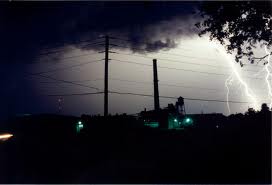
This week is National Lightning Safety Week.

It is everyone’s responsibility to be safe especially during thunder and lightning
imagesCA942DFB

Here’s a few free tips you can use to prepare for severe weather like lightning:

  • At any hint of thunder and/or lightning, move quickly to a safe shelter area. Remember the phrase: When Thunder Roars, Go Indoors!
  • Immediately postpone all outdoor activities for everyone…including adults!
  • Secure outdoor objects that could blow away or cause damage.
  • Break out your emergency preparedness kit and see if all flashlights are working. If not, get them in working order.
  • Charge all of your mobile devices including your cell phone now before the power goes out.

To get up to the minute updates during the Thunderstorm:

  • Use your battery operated NOAA Weather Radio for updates from the National Weather Service.

And after the storm passes, take these precautions as you survey the damage around your house:

  • Do NOT touch downed power lines. Assume all lines are charged and dangerous. Call your emergency services to handle safe removal of lines.
  • Power out? Check the power company’s website from your mobile smart phone to see who else doesn’t have power here.

Feel free to share these tips with your neighbors throughout the year.

@rusnivek

Participating in FEMA’s #PrepareAthon Google Hangout #Prepared2014

Participating in the White House Google Hangout now.

Glad to see engagement from numerous agencies especially Craig Fugate (@CraigAtFEMA) and Paulette Aniskoff (@PAniskoff44).

IMG_7840

…and Paulette Aniskoff just asked my question.
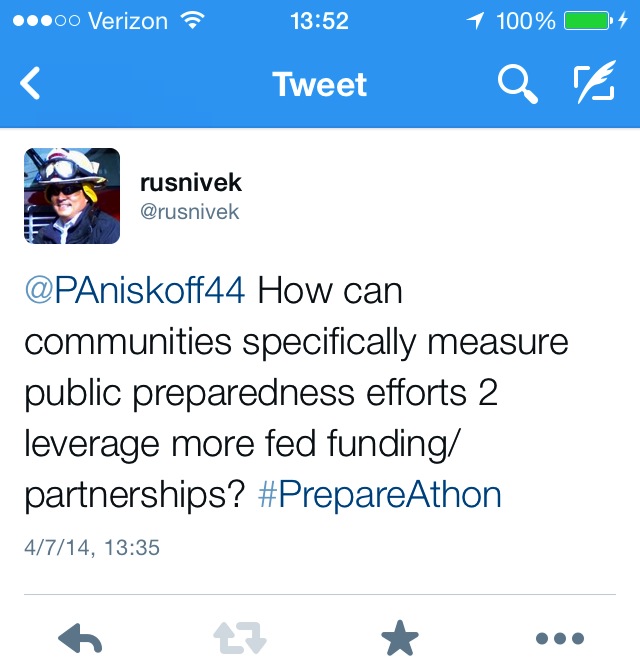
question

And Craig responded.

Holy. Balls.

@rusnivek


Tsunami warning? Are you on Kauai? #HITsunami
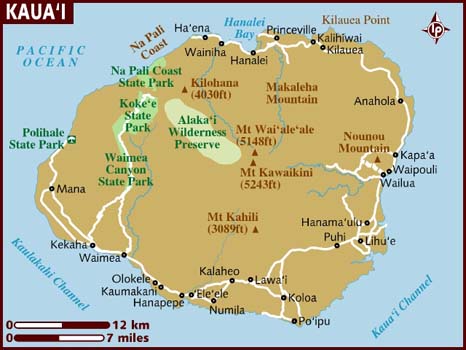
Tsunami warning? Are you on Kauai?

map_of_kauai


Check if you are in an evacuation zone here (FREE):

Before a Tsunami

  • To begin preparing, you should build an emergency preparedness kit and make a family communications plan.
  • Talk to everyone in your household about what to do if a tsunami occurs. Create and practice an evacuation plan for your family. Familiarity may save your life. Be able to follow your escape route at night and during inclement weather. You should be able to reach your safe location on foot within 15 minutes. Practicing your plan makes the appropriate response more of a reaction, requiring less thinking during an actual emergency.
  • If the school evacuation plan requires you to pick your children up from school or from another location. Be aware telephone lines during a tsunami watch or warning may be overloaded and routes to and from schools may be jammed.
  • Knowing your community’s warning systems and disaster plans, including evacuation routes.
  • Know the height of your street above sea level and the distance of your street from the coast or other high-risk waters. Evacuation orders may be based on these numbers.
  • If you are a tourist, familiarize yourself with local tsunami evacuation protocols. You may be able to safely evacuate to the third floor and higher in reinforced concrete hotel structures.
  • If an earthquake occurs and you are in a coastal area, turn on your radio to learn if there is a tsunami warning.


During a Tsunami

  • Follow the evacuation order issued by authorities and evacuate immediately. Take your animals with you.
  • Move inland to higher ground immediately. Pick areas 100 feet (30 meters) above sea level or go as far as 2 miles (3 kilometers) inland, away from the coastline. If you cannot get this high or far, go as high or far as you can. Every foot inland or upward may make a difference.
  • Stay away from the beach. Never go down to the beach to watch a tsunami come in. If you can see the wave you are too close to escape it. CAUTION – If there is noticeable recession in water away from the shoreline this is nature’s tsunami warning and it should be heeded. You should move away immediately.
  • Save yourself – not your possessions.
  • Remember to help your neighbors who may require special assistance – infants, elderly people, and individuals with access or functional needs.


After a Tsunami

  • Return home only after local officials tell you it is safe. A tsunami is a series of waves that may continue for hours. Do not assume that after one wave the danger is over. The next wave may be larger than the first one.
  • Go to a designated public shelter if you have been told to evacuate or you feel it is unsafe to remain in your home. Text SHELTER + your ZIP code to 43362 (4FEMA) to find the nearest shelter in your area (example: shelter 12345).
  • Avoid disaster areas. Your presence might interfere with emergency response operations and put you at further risk from the residual effects of floods.
  • Stay away from debris in the water; it may pose a safety hazard to people or pets.
  • Check yourself for injuries and get first aid as needed before helping injured or trapped persons.
  • If someone needs to be rescued, call professionals with the right equipment to help. Many people have been killed or injured trying to rescue others.
  • Help people who require special assistance—infants, elderly people, those without transportation, people with access and functional needs and large families who may need additional help in an emergency situation.
  • Continue using a NOAA Weather Radio or tuning to a Coast Guard station or a local radio or television station for the latest updates.
  • Stay out of any building that has water around it. Tsunami water can cause floors to crack or walls to collapse.
  • Use caution when re-entering buildings or homes. Tsunami-driven floodwater may have damaged buildings where you least expect it. Carefully watch every step you take.
  • To avoid injury, wear protective clothing and be cautious when cleaning up.


For more information, check out www.ready.gov

@rusnivek

Tsunami warning? Are you on Hawaii? Big Island? Hilo? Kona? #HITsunami
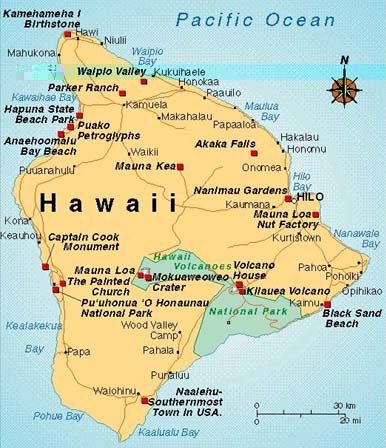
Tsunami warning? Are you on Hawaii? Big Island? Hilo? Kona?

hawaii_map


Check if you are in an evacuation zone here (FREE):

Before a Tsunami

  • To begin preparing, you should build an emergency preparedness kit and make a family communications plan.
  • Talk to everyone in your household about what to do if a tsunami occurs. Create and practice an evacuation plan for your family. Familiarity may save your life. Be able to follow your escape route at night and during inclement weather. You should be able to reach your safe location on foot within 15 minutes. Practicing your plan makes the appropriate response more of a reaction, requiring less thinking during an actual emergency.
  • If the school evacuation plan requires you to pick your children up from school or from another location. Be aware telephone lines during a tsunami watch or warning may be overloaded and routes to and from schools may be jammed.
  • Knowing your community’s warning systems and disaster plans, including evacuation routes.
  • Know the height of your street above sea level and the distance of your street from the coast or other high-risk waters. Evacuation orders may be based on these numbers.
  • If you are a tourist, familiarize yourself with local tsunami evacuation protocols. You may be able to safely evacuate to the third floor and higher in reinforced concrete hotel structures.
  • If an earthquake occurs and you are in a coastal area, turn on your radio to learn if there is a tsunami warning.


During a Tsunami

  • Follow the evacuation order issued by authorities and evacuate immediately. Take your animals with you.
  • Move inland to higher ground immediately. Pick areas 100 feet (30 meters) above sea level or go as far as 2 miles (3 kilometers) inland, away from the coastline. If you cannot get this high or far, go as high or far as you can. Every foot inland or upward may make a difference.
  • Stay away from the beach. Never go down to the beach to watch a tsunami come in. If you can see the wave you are too close to escape it. CAUTION – If there is noticeable recession in water away from the shoreline this is nature’s tsunami warning and it should be heeded. You should move away immediately.
  • Save yourself – not your possessions.
  • Remember to help your neighbors who may require special assistance – infants, elderly people, and individuals with access or functional needs.


After a Tsunami

  • Return home only after local officials tell you it is safe. A tsunami is a series of waves that may continue for hours. Do not assume that after one wave the danger is over. The next wave may be larger than the first one.
  • Go to a designated public shelter if you have been told to evacuate or you feel it is unsafe to remain in your home. Text SHELTER + your ZIP code to 43362 (4FEMA) to find the nearest shelter in your area (example: shelter 12345).
  • Avoid disaster areas. Your presence might interfere with emergency response operations and put you at further risk from the residual effects of floods.
  • Stay away from debris in the water; it may pose a safety hazard to people or pets.
  • Check yourself for injuries and get first aid as needed before helping injured or trapped persons.
  • If someone needs to be rescued, call professionals with the right equipment to help. Many people have been killed or injured trying to rescue others.
  • Help people who require special assistance—infants, elderly people, those without transportation, people with access and functional needs and large families who may need additional help in an emergency situation.
  • Continue using a NOAA Weather Radio or tuning to a Coast Guard station or a local radio or television station for the latest updates.
  • Stay out of any building that has water around it. Tsunami water can cause floors to crack or walls to collapse.
  • Use caution when re-entering buildings or homes. Tsunami-driven floodwater may have damaged buildings where you least expect it. Carefully watch every step you take.
  • To avoid injury, wear protective clothing and be cautious when cleaning up.


For more information, check out www.ready.gov

@rusnivek

Tsunami warning? Are you on Maui? #HITsunami
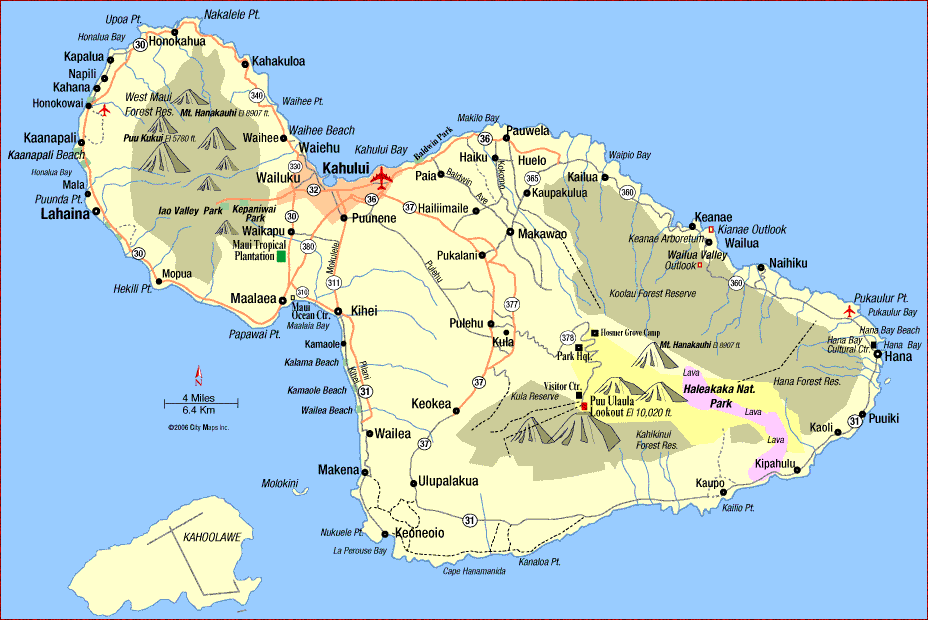
Tsunami warning? Are you on Maui?


maui

Check if you are in an evacuation zone here (FREE):

Before a Tsunami

  • To begin preparing, you should build an emergency preparedness kit and make a family communications plan.
  • Talk to everyone in your household about what to do if a tsunami occurs. Create and practice an evacuation plan for your family. Familiarity may save your life. Be able to follow your escape route at night and during inclement weather. You should be able to reach your safe location on foot within 15 minutes. Practicing your plan makes the appropriate response more of a reaction, requiring less thinking during an actual emergency.
  • If the school evacuation plan requires you to pick your children up from school or from another location. Be aware telephone lines during a tsunami watch or warning may be overloaded and routes to and from schools may be jammed.
  • Knowing your community’s warning systems and disaster plans, including evacuation routes.
  • Know the height of your street above sea level and the distance of your street from the coast or other high-risk waters. Evacuation orders may be based on these numbers.
  • If you are a tourist, familiarize yourself with local tsunami evacuation protocols. You may be able to safely evacuate to the third floor and higher in reinforced concrete hotel structures.
  • If an earthquake occurs and you are in a coastal area, turn on your radio to learn if there is a tsunami warning.


During a Tsunami

  • Follow the evacuation order issued by authorities and evacuate immediately. Take your animals with you.
  • Move inland to higher ground immediately. Pick areas 100 feet (30 meters) above sea level or go as far as 2 miles (3 kilometers) inland, away from the coastline. If you cannot get this high or far, go as high or far as you can. Every foot inland or upward may make a difference.
  • Stay away from the beach. Never go down to the beach to watch a tsunami come in. If you can see the wave you are too close to escape it. CAUTION – If there is noticeable recession in water away from the shoreline this is nature’s tsunami warning and it should be heeded. You should move away immediately.
  • Save yourself – not your possessions.
  • Remember to help your neighbors who may require special assistance – infants, elderly people, and individuals with access or functional needs.


After a Tsunami

  • Return home only after local officials tell you it is safe. A tsunami is a series of waves that may continue for hours. Do not assume that after one wave the danger is over. The next wave may be larger than the first one.
  • Go to a designated public shelter if you have been told to evacuate or you feel it is unsafe to remain in your home. Text SHELTER + your ZIP code to 43362 (4FEMA) to find the nearest shelter in your area (example: shelter 12345).
  • Avoid disaster areas. Your presence might interfere with emergency response operations and put you at further risk from the residual effects of floods.
  • Stay away from debris in the water; it may pose a safety hazard to people or pets.
  • Check yourself for injuries and get first aid as needed before helping injured or trapped persons.
  • If someone needs to be rescued, call professionals with the right equipment to help. Many people have been killed or injured trying to rescue others.
  • Help people who require special assistance—infants, elderly people, those without transportation, people with access and functional needs and large families who may need additional help in an emergency situation.
  • Continue using a NOAA Weather Radio or tuning to a Coast Guard station or a local radio or television station for the latest updates.
  • Stay out of any building that has water around it. Tsunami water can cause floors to crack or walls to collapse.
  • Use caution when re-entering buildings or homes. Tsunami-driven floodwater may have damaged buildings where you least expect it. Carefully watch every step you take.
  • To avoid injury, wear protective clothing and be cautious when cleaning up.


For more information, check out www.ready.gov

@rusnivek

Tsunami warning? Are you on Oahu? Honolulu? #HITsunami
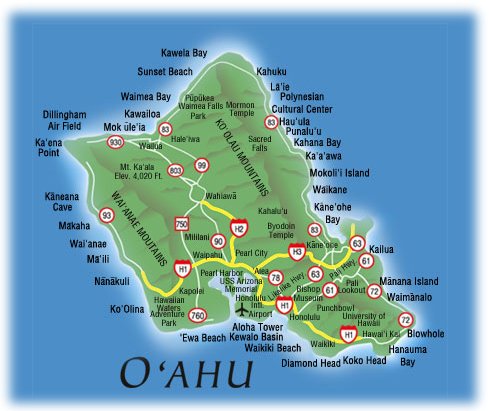
Tsunami warning? Are you on Oahu? Honolulu?

oahu_map

Check if you are in an evacuation zone here (FREE):

Before a Tsunami

  • To begin preparing, you should build an emergency preparedness kit and make a family communications plan.
  • Talk to everyone in your household about what to do if a tsunami occurs. Create and practice an evacuation plan for your family. Familiarity may save your life. Be able to follow your escape route at night and during inclement weather. You should be able to reach your safe location on foot within 15 minutes. Practicing your plan makes the appropriate response more of a reaction, requiring less thinking during an actual emergency.
  • If the school evacuation plan requires you to pick your children up from school or from another location. Be aware telephone lines during a tsunami watch or warning may be overloaded and routes to and from schools may be jammed.
  • Knowing your community’s warning systems and disaster plans, including evacuation routes.
  • Know the height of your street above sea level and the distance of your street from the coast or other high-risk waters. Evacuation orders may be based on these numbers.
  • If you are a tourist, familiarize yourself with local tsunami evacuation protocols. You may be able to safely evacuate to the third floor and higher in reinforced concrete hotel structures.
  • If an earthquake occurs and you are in a coastal area, turn on your radio to learn if there is a tsunami warning.


During a Tsunami

  • Follow the evacuation order issued by authorities and evacuate immediately. Take your animals with you.
  • Move inland to higher ground immediately. Pick areas 100 feet (30 meters) above sea level or go as far as 2 miles (3 kilometers) inland, away from the coastline. If you cannot get this high or far, go as high or far as you can. Every foot inland or upward may make a difference.
  • Stay away from the beach. Never go down to the beach to watch a tsunami come in. If you can see the wave you are too close to escape it. CAUTION – If there is noticeable recession in water away from the shoreline this is nature’s tsunami warning and it should be heeded. You should move away immediately.
  • Save yourself – not your possessions.
  • Remember to help your neighbors who may require special assistance – infants, elderly people, and individuals with access or functional needs.


After a Tsunami

  • Return home only after local officials tell you it is safe. A tsunami is a series of waves that may continue for hours. Do not assume that after one wave the danger is over. The next wave may be larger than the first one.
  • Go to a designated public shelter if you have been told to evacuate or you feel it is unsafe to remain in your home. Text SHELTER + your ZIP code to 43362 (4FEMA) to find the nearest shelter in your area (example: shelter 12345).
  • Avoid disaster areas. Your presence might interfere with emergency response operations and put you at further risk from the residual effects of floods.
  • Stay away from debris in the water; it may pose a safety hazard to people or pets.
  • Check yourself for injuries and get first aid as needed before helping injured or trapped persons.
  • If someone needs to be rescued, call professionals with the right equipment to help. Many people have been killed or injured trying to rescue others.
  • Help people who require special assistance—infants, elderly people, those without transportation, people with access and functional needs and large families who may need additional help in an emergency situation.
  • Continue using a NOAA Weather Radio or tuning to a Coast Guard station or a local radio or television station for the latest updates.
  • Stay out of any building that has water around it. Tsunami water can cause floors to crack or walls to collapse.
  • Use caution when re-entering buildings or homes. Tsunami-driven floodwater may have damaged buildings where you least expect it. Carefully watch every step you take.
  • To avoid injury, wear protective clothing and be cautious when cleaning up.


For more information, check out www.ready.gov

@rusnivek