Bridges are out…now whut? #NatlPrep

As we near the end of the first week, we should also consider our planning and look at evacuation routes. As far as things go, most major routes should be open esp in emergency to allow for those who need to egress to GTFO of there right?!?

While in perfect situations, this would be the case. But lately, we’ve had some challenging situations across the nation that leads me to believe we may not have the option to evacuate safety out of the city.

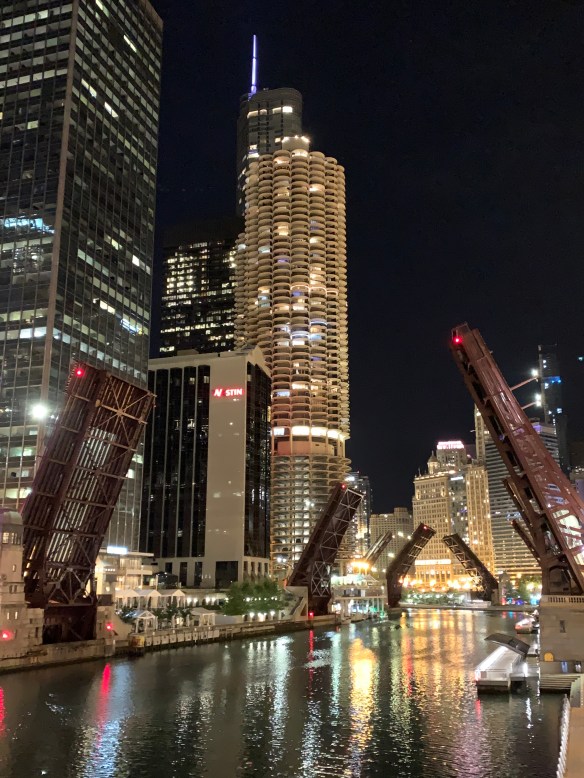
While most days, all the bridges are down in Chicago.

Chicago Hotel Packages Add Spice to the Weekend

However the City of Chicago has had some bad luck and was forced to pop the bridges to curtail silly behavior at night.

With almost all the bridges up, that makes travel through the loop a bit more complex and challenging esp when things happen last minute and late at night.
To help deal with these challenging situations, subscribing to the mass notification systems would provide additional information on which roads are closed but amidst the ruckus, perhaps planning alternate routes out of your location would be best.

Easier said than done but necessary when faced with pressures of the safety of yourself and your family.

While it doesn’t have to be a straight shot out, you can exercise various options on how to exit your location and safely rondevous with loved ones in other places.

Remember, plan at least two alternate routes of egress from your location and try your hardest to reduce the amount of complexity after a disaster/emergency.

As always, remain vigilant and make sure you and your family are safe by planning now.

Reporting live on AlohaFriday…

@rusnivek

Plan for shelter and outside meeting location with your family #NatlPrep

We’re still in the first week of National Preparedness Month, we need to examine shelter locations. Yes I said planning for shelter locations.

Because if this is your shelter idea…
…you might want to rethink your plan.

If you plan for a proper shelter location WITH your family, you’d likely be rewarded with a more comfortable situation. Food, water, etc….are nice things to have. But the last thing anyone needs during a crisis is more things to think about and burden you down.

No one has time for that!

Ain't Nobody Got Time for That… – Danny Dainton

Interior rooms with no windows is always a good shelter location esp during a tornado strike. Not only is it interior, but you can seek further shelter/cover underneath the counter top.

Nice!

After the danger passes, a simple meeting place outside is a good idea too.It should be a relatively easy to find location that everyone knows and can rally up. Also be identifiable from great distances. Something tall and unique could be used too.

Don’t be the bearer of bad news…make sure everyone knows the plans!

Since most of you are home, consider taking the time to assessing your situation, evaluate your options, and make good decisions. But no matter where it is, be sure to tell the rest of your family where to go in case of emergency.

Plan for stuff to happen right? Just look at us now.

2020 Sucks - Year 2020 - Sticker | TeePublic

Worst. Year. Ever.

Reporting live from the first week of National Preparedness week!

@rusnivek

How I find out the latest deets on stuff #NatlPrep

Since this is only the second day of 2020 National Preparedness month, we needed to focus in on your plans before, during, and after an emergency.

On the regular, I get TONS of calls/inquiries from people trying to figure out what’s going on. Many of our friends/families can glean this same info I get from the mass notification systems already in place.

The City of Chicago (IL) Office of Emergency Management and Communications (OEMC) has an easy system called NotifyChicago.

By inputting your information and particular way to be contacted, you can get the most up-to-date information about any part of the city. This includes warnings, hazards, and of course major street closures due to riots, protests, or other weird things that happen in Chicago. Choosing to be notified via text message ensures that no matter where you are, you can be alerted to dangers in your area 24/7. Subscribe for free here: https://www.chicago.gov/city/en/depts/oem/provdrs/alertchicago/svcs/notifychicago.html

At the county level, DuPage County (IL) Office of Homeland Security and Emergency Management (OHSEM) uses the Smart911 system which is a mass notification system to alert anyone on issues at the county level.

This could include severe weather, road closures, as well as critical information for anyone living/working in the area. You can sign up here: https://www.smart911.com/

From the region:

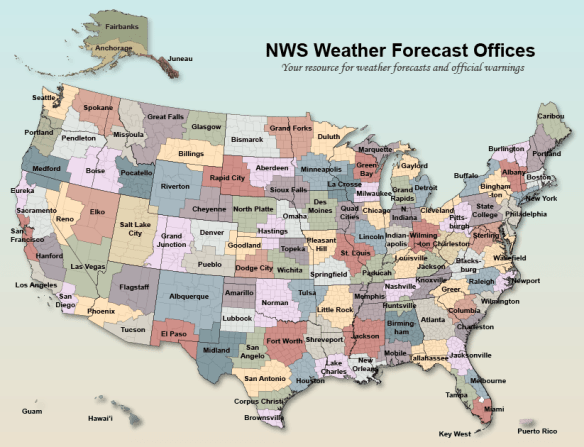
I rely heavily on our partners from the National Weather Service. While not the primary way, I think their social media work on Twitter is excellent and pull lots of info from them using the alert feature (notifications on) function on Twitter.

Consider following Mike Bardou and the crew from the NWS Chicago or follow your own local NWS office for immediate weather info. There are 122 Weather Forecasting Offices across our great nation.

More details can be found here: https://www.weather.gov/srh/nwsoffices

And finally, with the amount of info and the onslaught of information being pushed to our mobile devices, it’s good to know that IF it’s too much, you can always unsubscribe to any these services.

IF you have family in other parts of the country, consider subscribing to their area notifications. Doesn’t hurt to help a loved one out as they maybe be too busy, sleeping, or incapable of understanding the severity of their situation. More on that tomorrow.

Keep it safe during this first week of National Preparedness Month by making your plan!

@rusnivek

Today at 1017 #ShakeOut

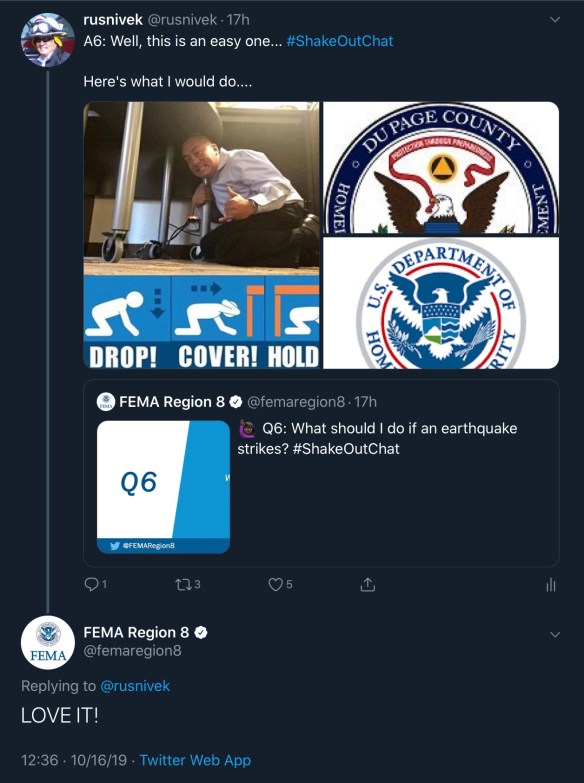
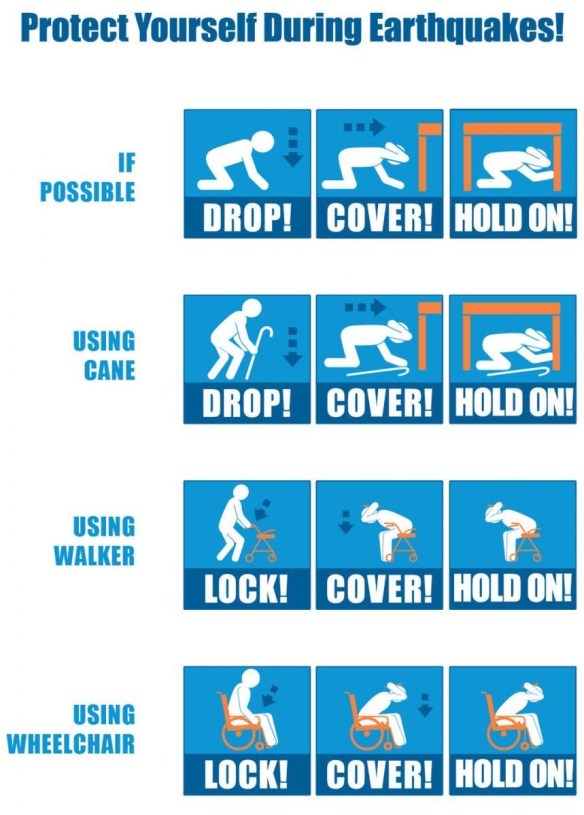
Today is International ShakeOut day where at 10:17am (your time zone) we should all practice earthquake safety!

Soooooo, in case you need some ideas on what to do, here is my plan.

Seems like FEMA Region-8 approves!

Shout out to the FEMA Region-8 peeps who ran the Twitter #ShakeOutChat yesterday. Lots of great ideas on preparedness as well as what to do during an earthquake.

So no matter who or where you are…

Take a moment and assess your options BEFORE an earthquake strikes.

For more information on earthquake preparedness tips, check out Ready.Gov earthquake‘s page!

@rusnivek

The new 2019 ICS-400 this week!

Good morning peeps – welcome to the new 2019 ICS-400: Advanced ICS!

Proud to be one of the first instructors to roll this course out to our public safety partners that popped in late July. This week’s class? We have a bunch of pros from all backgrounds including Fire, EMS, Police, Healthcare, Public Works, Communications, Health Department, National Guard, Civil Support Teams, State, VA, Intelligence, and Tribal nations. I’m proud to serve all these pros.

Lots of discussion on preparedness efforts esp with some of the projected large disasters from across the country. In fact, discussion on preparedness for Cascadia Rising, New Madrid Fault, and national infrastructure failures were consistently discussed through the day. Related note: Proud to hear of sooo many prepared pros in class this week.

Classically, lots to share as Emergency Management pros continues to coordinate response through training and exercises. Train like you fight right?

Aside from powerpoints, the new ICS-400 has a bunch of in class activities that talk about complex incidents, Unified Command, and area command. Productively discussing issues in class BEFORE a disaster can only help to understand challenges that many agencies face…which could be exacerbated during crisis/emergency.

Glad to have engaged professionals in class this week.

Get your ICS on!

@rusnivek

All five phases of Emergency Management in one picture

One way we can teach our community (using Emergency Management concepts)…..is flooded roadways. Yep, that’s right, we often have the general public drive their cars through flooded roadways and get into trouble, injured, or die.

So lemme break it down in our five phases of Emergency Management

Statement: One of the common emergencies Emergency Management see during heavy rains is flooding.

Mitigation: In past flooding, Emergency Management have identified areas that are susceptible for flooding that is unsafe for any safe passage under this bridge.

Preparedness: Emergency Management has painted a highly visible ruler on the bridge pillar to help public safety (or anyone) to address and evaluate the water levels.

Protection: By identifying the dangers, Emergency Management is better able to coordinate resources used to protect the public as we can now focus our efforts on barriers, caution tape, road closures, etc…

Response: During terrible weather, Emergency Management can share critical safety messages with the public and allocate more resources used to rescue individuals who did NOT heed the warnings.

Recovery: Thanks to proper preplanning, Emergency Management can reference pictures of this flooded area that can be leveraged against non-disaster time pictures which can provide good background for windshield surveys and damage assessments for state, regional, and Federal partners.

Boom.

Good way to improve the safety of your municipality.

Great way to enhance your operational coordination and recovery efforts.

Outstanding way to improve the resilience of your community.

Can you do this in your community? You sure can, just contact your local Emergency Management Agency for more details.

@rusnivek

Debris Management with MassEMA

Despite not wearing pink today, we got a solid start to a great response and recovery course here in Massachusetts today.

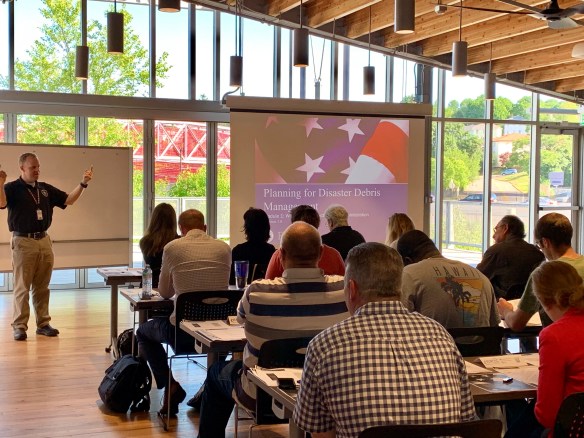
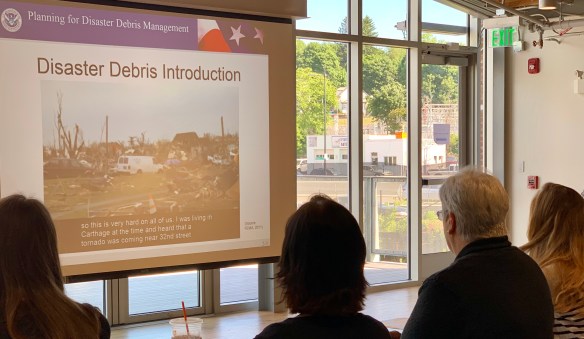
Great introduction to the DHS/FEMA/NDPTC Debris Management Planning class. Outstanding to work with the Emergency Management Pros again from MassEMA and FEMA Region 1.

Glad to share the same mission and goals as the MassDEP, all agencies need to work together as we decrease our response times in a disaster.

Often times, people believe Debris Management is only for recovery. It isn’t. Debris Management starts in the response phase with local public works resources supporting Fire, EMS, and Police in their initial response.

Yes that’s right, response phase.

Even more surprising is that public works pros (ESF-3) are an integral part of any response plan and should be included as agencies enhance their disaster plans.

Funding is often a challenge as agencies continue to struggle w/ funding and maintaining resources for public works. But sharing ideas and resources could help mitigate deficiencies and increase capabilities for our partners in ESF-03.

As we continue to facilitate good conversation, we often talk about burn rates and projections to ensure that we are consistently bringing in resources to any disaster to best serve the communities that are affected.

We get laser focused on our top-3 primary response agencies from Fire, EMS, and Police. However, Emergency Management Professionals will tell you that we should include more into our preparedness and response phase to better serve our communities.

Coordination will enhance

  • Asset allocation
  • Response priorities
  • Critical access
  • Reduce costs and burn rates
  • Operational coordination

These points are critical as communities deal with the initial hit of any disaster.

So no matter large or small, urban or rural, or even rich or poor – any community is vulnerable. Proper planning will help reduce the risk so that we can continue to serve those survivors who need it the most.

Also, glad to see participants getting a lot out of class and instructor enthusiasm on the importance of this Emergency Management topic.

I’d encourage you to look at your Emergency Operations Plan (EOP) and realistically look at the response from Public works as they are truly a partner in our preparedness, response, and recovery of any big event or disaster.

@rusnivek

Forming the proverbial PIO Voltron for today’s FEMA JIC/JIS course

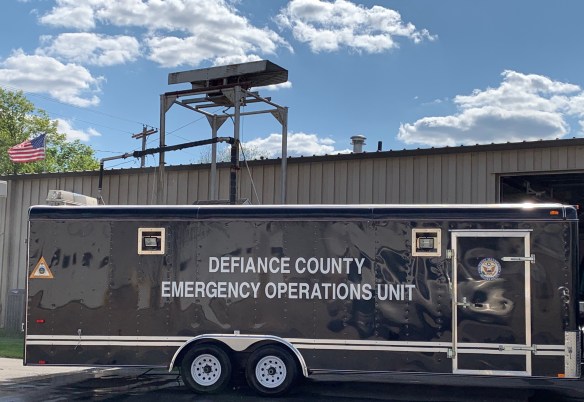
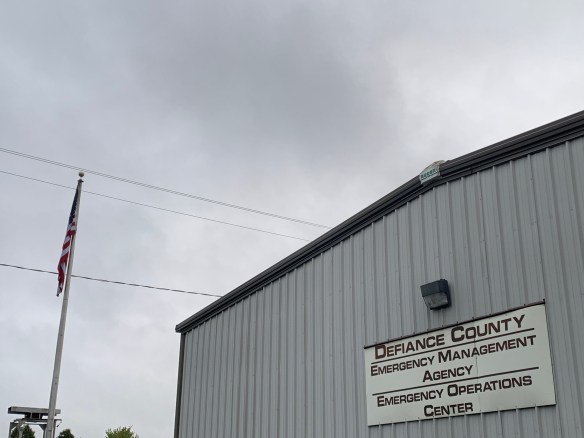
And now starting the FEMA JIC/JIS Course with our class here at the Defiance County EMA Emergency Operations Center.

And yes, if you’ve been in a JIC/JIS class w/ me before, you know I talk about Voltron. In the FEMA Basic PIO Course, we teach you to be an individual PIO and function with limited options…however, the JIC/JIS course allows you to join forces with other PIOs and work the magic despite being from different backgrounds and different factions for the emergency or disaster. That’s right-we can all get along in the JIC.

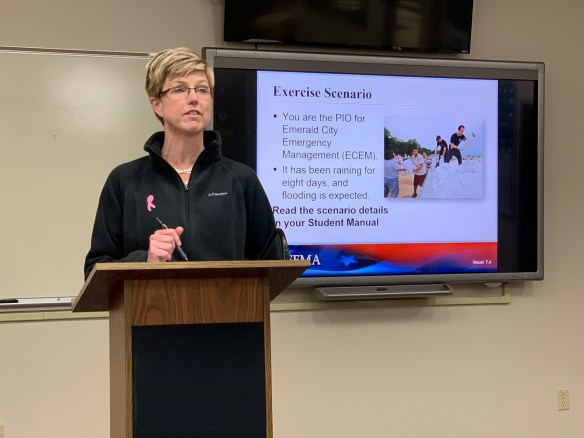
Starting out the day with a cold reality check on expectations and capabilities as we assess our options and ready our agencies for disasters. It would be a good idea to have a clear understanding of the situation and build from there.

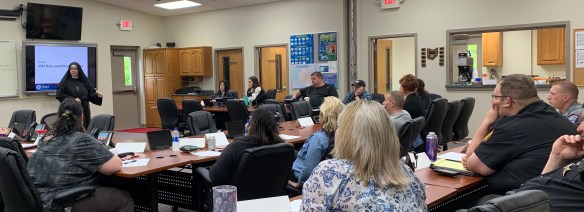
Additionally, we bring our all-hazards partners into the fold. Here’s Sister Michael Marie talking about the complexities of what appears as a simple emergency that could quite result in bringing soooooooooooooooooooooo many partners to respond to this typical emergency.

Drawing too simple for you?

You need more description?

NO SOUP FOR YOU!

The whole point of the exercise is to get your mind thinking about various options as well as partners to call early as likely, they have a dog in the fight to help any affected community recover from any disaster.

Look, it’s more than Fire, Police, and EMS – it’s the #WholeCommunity to build a culture of preparedness.

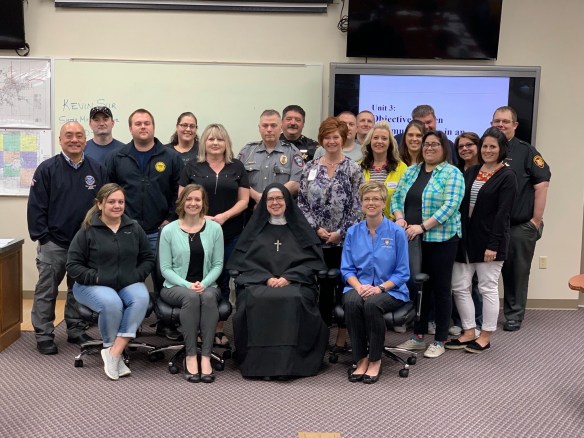
Proud of every single one of these participants as everyone walked away with a new understanding and respect for the PIO. While some have been on TV before w/ a few interviews, all of them realize the dangers of an unprepared interviewee.

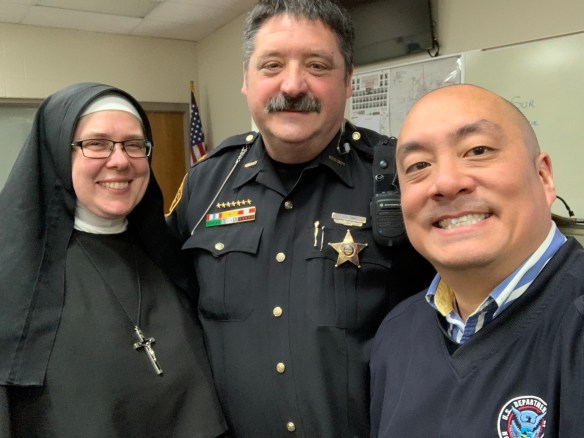
Looking forward to working with all of you on the next big one. And just think…in the midst of a disaster, you just might see these two smiling faces.

Now, go forth and use your new PIO powers for good!

@rusnivek

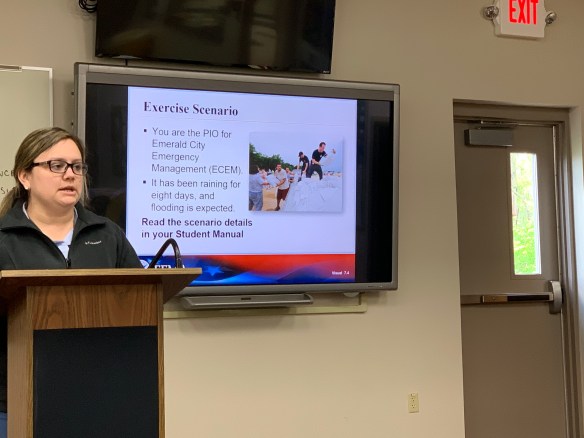
Day-2 of the FEMA Basic Public Information Officer course here at Defiance County EMA

Day-2 of the FEMA OEMA Basic Public Information Officer course here at Defiance County EMA.

As we start to expand the roles of the PIO, we gotta talk about social media and the impact it has on our every day tasks representing our brand…aka our agency.

Like all info on social media, there’s a ton of things to cover and we won’t be able to talk about ALL platforms. But we can talk about the primary ones that make a difference for any public safety agency.

Also a good time to share one thoughts with you too:

“I don’t care how many followers you have, I care about how you engage all of the followers you do have.” – @rusnivek

Much like Shania Twain, the volume of followers don’t impress me much. What makes a really good social media-er, is how that agency engages with their followers they do have.

I often get asked about in class mock interviews. We still do them as they are incredibly important for participants in a safe learning environment.

But ask any of my participants. They will tell you that it’s pretty real.

Additionally, how I facilitate that part of class nurtures and allows for self-reflection amongst all participants. This ain’t my first rodeo. My peeps are good as we prep them for a really bad day.

Mock press conferences allow our participants to put together a few skills they learned just yesterday.

Just like real press conferences, mock reporters are able to ask questions and test some techniques on running a successful press conference.

The best part?

Participants worked it like pros and did an excellent job in running the pressers! NOOICE!!!!!

Great teamwork and collaboration with everyone here. Strong support network, solid coordination, and nice weather – always a winner!

Proud of the work from everyone in class today.

I’m totes looking forward to tomorrow’s course – FEMA JIC/JIS Course

@rusnivek

FEMA Basic PIO Course here at Defiance County EMA

It’s just another Manic Monday as we start another FEMA OEMA Basic PIO Course here at Defiance County Emergency Management Agency (Ohio). Cue the Guns n Roses intro music!

Not going to lie, all signs point to a large contingent from our law enforcement community here today.

Lots of new PIOs in the audience today as we try to share the good word from so many agencies. Almost every ESF is represented!

All-hazards coolio on Monday!

As an added instructor bonus, we get a chance to see what campaigns that Ohio EMA has worked for previous outreach activities in Ohio. Hi Nancy!!!!!

My lunch time views include a few red fire trucks.

Ahhhhh, I feel better now.

And in classic fashion, we are most definitely doing on-camera interviews.

While seemingly insignificant, this is the part of the class that participants find is the most valuable for their ongoing career.

Me? I’d rather you have that experience and training and never use it vs never having that training and then being thrown to the wolves in a crisis or emergency.

Train like you fight right?

Reporting live from the EOC as I ask those challenging media-esque questions…

@rusnivek