As promised, here’s my quick initial review of ello.

It’s only been a few days…so I figured since everyone isn’t on it, this might help show some of the difference between this new emerging social media platform compared to others.
Here’s a quick news package story from the founders of ello.co from Vermont.
Hot Social Network Ello Starts in Vermont
(Love the small town local news)
For those that think this is like Facebook? Nope. The company’s mantra of a simple ad-free platform is as plain jane as can be. Not much there. In fact,
Few initial notes I have on ello:
- Comments are a bit weird as they are currently in a separate box which is unattached to the picture you upload.
- The gigantic fat Noise button – I’m still unclear on what that is. I feel like it’s kinda like the “I’m Feeling Lucky” button on Google.
- No search feature.
- No geolocation feature
- I think more people are talking about ello on FB, Twitter, Insta, Vine, Snapchat, etc….than people actually ON ello.
- No hashtag or category use
- Stop trying to force me to Say Ello…But I WILL say ello with a horrible British accent
- No trending topics.
- After I post an update (or Say Ello…) Why do I have to move my cursor over to the “Post–>” button?
- No popular happenings.
- Finding friends is hard. Not cool. They are my friends.
- No app.
- Feels awfully like Tumblr.
- It’s difficult to find friends because I have to first find them individually on their own page and then follow them. I can not pick them up from a list.
- Kinda google plus-ie eh?
- ello email notifications are simply notifications. It does not include the comment or response. Cannot be used for “documentation”. No point in Email notifications if you don’t notify me of what the message is.
- Description is about the same, but not as prominent as Twitter.
- Website link is there. Hope that ello will add a “preview” of website there.
- Location? Hometown? Where U AT?
- Trending based topics is not searchable (at this time).
- Not having some sort of “rules” for picture posting, the pictures that are posted are either really wide or vertical. Not much semblance in fitting into screen.
- Links to sites do NOT preview. FB does that.
- No info provided on the analytics of views aka shown by the eyeball. Maybe that will come after beta.
- Archiving for security.
- When is ello projected to be out of beta?
- List of people or things that I could follow too? When I find others similar to me, I want to see what they follow. I am assuming that we have similar interests. Hoping a future column to be added later in ello.
- Posted times are approximate. Public safety demands exacts so I hope they put a more accurate time of post rather than “~11h”
- Filters are absent.
- Multiple picture uploads are not happening. Maybe that’s too cluttered for their “clean” layout.
- x5 invites only to a closed social media platform? C’mon-what is this?!? 2003?!?!!?
- @WTF….I mean policies/information tab. Hilarious, but very techy.
- Formatting of posts using ** or * is kinda programmerish. Tron aficionados will love it, but not everyone programs…so this type of lingo isn’t going to fly for very long.
- In the “Say Ello…” box (aka status box) I find it weird that they tell you to Say Ello….when you really are going to write a comment about something else.
- Reposting isn’t as inviting as FB’s “Share” button – and not easy to find.
- On ello, you do not have to use your real name. but in the WTF rules, ello has their rose colored glasses on and “The Don’t impersonate others. Be yourself, or a version of yourself. Please don’t pretend to be someone else.”
- Mobile ello is way better than desktop ello.
- DYK: ello.com is different than ello.co
- Advise your SM followers to turn off autofill or muscle memory of “co” vs “com”
- Funny fact: Someone created a Mark Zuckerberg profile on ello.com – and it wasn’t Zuck.
- Circle profiler picture is neeto, but I think I like square.
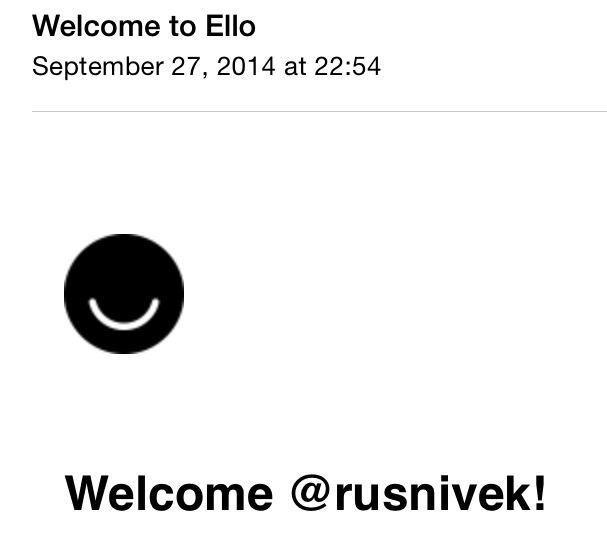
- The ello logo is kinda creepy w/ no eyes right?
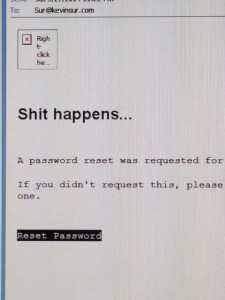
Forgot your password? I tested their forgot password send. The emailed reminder is hilarious, but NSFW. This kind of email would (obv) not pass work computer filters.
Testing browsers, I found a few interesting non-compliant issues.
- Desktop CPU / Windows-7 / Internet Explorer: Picture upload and layout/formatting issues
- Desktop CPU / Windows-7 / Chrome: Friends take up too much screen real-estate in widescreen format.
- Desktop CPU / Windows-7 / Safari: Too wide – again with the wide screen look (Maybe I’m too used to the vertical FB?)
- Desktop CPU / Windows-XP / IE: Picture uploading issues
- Desktop / Apple / Safari: Spread out (widescreen awkward formatting)
- iPhone-5 / Safari: MUCH better layouts
- iPad-Air / Safari: Better screen formatting and (my guess) it looks like it was designed for tablet.
- Blackberry browser….who am I kidding. I haven’t seen one in the wild for 2 years now.
Ello’s HQ sent an email last night touting their recent successes. Cool.

I do enjoy the quick simple emails with picture.
But let’s be honest, most of the ello participants that are already on ello, were drawn to the line in the email last night…”

The use of “thingy” has me worried…and of course excited. Thanks Matt.
Well, since this is in beta, I’m sure there will be more good things to come. But at this time, I am doubtful will hold (DWH).
Not even close to ready for use during disasters or emergencies.
Because of the low participation and beta, this platform is not useful for preparedness or response or recovery or intelligence.
Special thanks to @schnick for the invite.
Maybe more good stuff from ello.co on the horizon.
@rusnivek