FireChat – First look 

FireChat – First Look
There has been lots of discussion about mobile message apps using MESH networks. Just like my deployment to Hurricane Katrina/Rita in Louisiana’s Lower 9th Ward, we had no cell service which means no internet. Common in disasters, many startups are looking to bridge that gap using Bluetooth/MESH networking for any type of mobile technology.


MESH networks literally work by using other devices in your general vicinity to relay/transmit data to any available network. Devices can automatically network with each other via flood technique (overwhelming) or routing technique (hardware hoping). To put it into terms that we in government are more used to hearing, this type of networking is considered a mobile ad-hoc network that can operate independently with little or no internet connection.

Some advantages include internet use with at least one actual connection, increasing local networking by locality through mobile hardware, and of course an automatic mobile-to-mobile network.

Some dangers include lack of security, mobile device protection, connection reliability, and as the MESH network grows the more prolonged data delays occur.

Soooooooooooo, just like when ello was released, I downloaded the app and started using it. I engaged with various users over the course of the last 4 weeks. Here’s my notes.

  • GPS data is incorrect. I was in Dallas’ airport and it pegged me in Natchitoches, LA.
  • Bluetooth is another way for MESH networks to communicate but strength of mobile-mobile connections is fleeting/passing in an airport
  • Hyperlinks do work.
  • When you upload a picture, FireChat does NOT give a confirmation message or pop-up that your picture is uploaded (I found this out because I uploaded my picture six times before I realized what was happening). #whoopsies
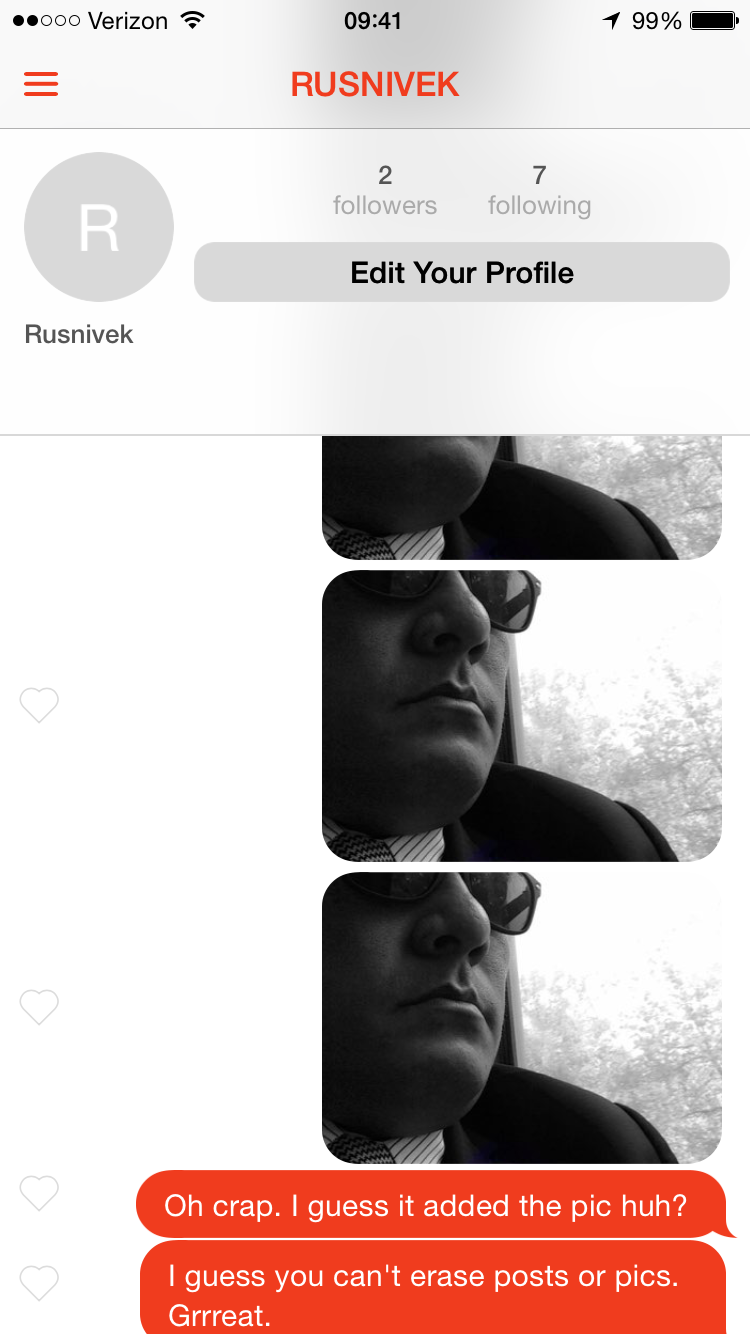
  • Aaaaand you cannot erase pictures.
  • Users cannot erase comments.
  • Hashtags help users identify topic and discussion.
  • Hashtags are hyperlinked in FireChat to those specific groups.
  • Twitter handles do NOT hyperlink to Twitter accounts
  • Phone numbers hyperlink to phone app (list using xxx-xxx-xxxx). It also works using the xxxxxxxxxx format but it looks cleaner and easier to recite w/ natural “-” breaks.
  • FireChat does not allow cut/paste function.
  • GPS coordinates do not hyperlink to any maps (Apple Maps or Google Maps)
  • USNG does not work either.
  • Refresh rate is slow (when compared to Twitter’s network refreshes faster and is more streaming).
  • In a known dead spot for cell service, MESH network was slow and did not connect to internet.
  • Trolls are rampant and uncontrolled in the main chatroom.
  • Main chatroom has various and NSFW topics.
  • Many users do not identify themselves with a profile picture or descriptor.
  • Many users are using this service as a social network for personal PERSONAL reasons.
  • Bad words are censored on FireChat with “*****”. Unknown what those specific terms are.
  • You can like a comment from others or about yourself. Other users can see that someone has liked the comment/content by the red heart displayed. No amount is quantified. Just one lonely red heart.

If Emergency Management was to use FireChat, designate a specialist to monitor to observe and engage pertinent conversation in main chat room directing them to distinct #group in FireChat.

At this time, I only use FireChat when I’m bored and want to see if they have developed other functionality tools.

Just a few initial thoughts on FireChat.

@rusnivek

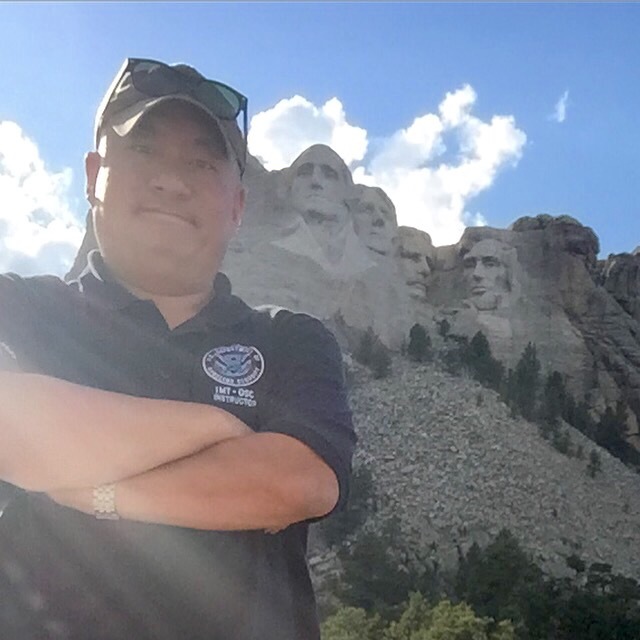
All-Hazards participants in today’s class in South Dakota

Here for the class today. Numerous all-hazards responders including US Department of Interior, Bureau of Land and Natural Resources (BLNR), US Forestry Service, FireAttack T-1/2 AHIMTs, local law enforcement, infrastructure, utilities, public safety comms, PIOs, healthcare, Tribal agencies, and Emergency Management professionals from South Dakota.


Nothing gets in the way of good training!


In breaking for lunch just now, participants asked if the fella over there with the hella good hair had any Taylor Swift.

Yes, I’m a very accommodating instructor – no problem!


Reporting live from the EOC…FEMA Region-8 baby!
@rusnivek

We got a #FacebookDown-Safety-PIO-SM-14-009

14-009: We got a FacebookDown
Agency: Los Angeles Sheriff’s Dept. Topic(s):         Non-related current event messages
Date: Fall 2014 Platform:        Facebook and Twitter

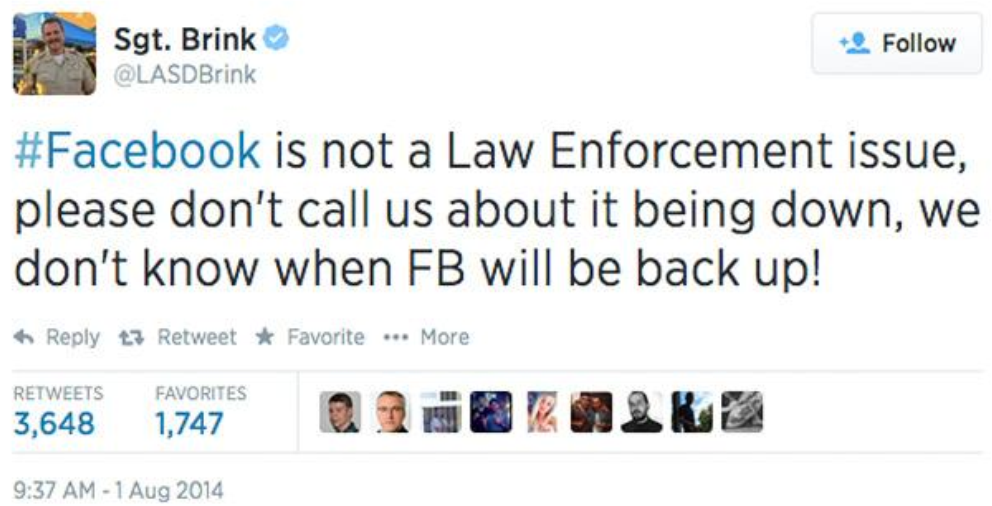
Just like any other service, social media platforms are bound to go down. And when that happens, a small amount of the population does NOT know how to react appropriately. Some residents of California decided that calling 9-1-1 was their only resort to getting logged back into Facebook.

IMG_5167

Ahem. Clearly, this is NOT an emergency. Sgt Brink is right in making it very clear to his audience (on Twitter) that Facebook’s non-service is not a Law Enforcement issue. Common sense right?

Most agencies should have an easy contingency plan when this type of situation happens. Social Media postings and engagement will help decrease calls to various public safety agencies…including during non-emergency times. So having this type of canned responses ready to push out when a major social media platform has the hiccups, might help your constituents navigate their (loss of) digital life. Additional use of a trending hashtag will bring more visibility to your post by informing others of actions, or in this case, non-actions.

A more effective tweet could have read:

#Facebook is NOT a law enforcement issue. Pls don’t call us about it being down, we don’t know when FB will be back up #facebookdown

By phrasing it this way:

  1. You sternly address that this social media platform is NOT a law enforcement matter (duh).
  2. You use a hashtags that is trending (#Facebookdown) that will help increase visibility in your tweets.
  3. You highlight the importance of being current and active on recent news/events.
  4. You stress the importance of engaging with your social media users on various social media platforms.

Time is valuable, so tweet good stuff.


@rusnivek


***To download this as a single-page printable format, click this file:

WeGotAFacebookDown-Safety-PIO-SM-14-009


Your image on social by monitoring your name Safety-PIO-SM-14-007

14-007: Your image on social by monitoring your name
Agency: Lakewood Fire Topic(s):         Monitoring your name/branding
Date: Fall 2014 Platform:        Twitter

Monitoring your namesake has been debated for years. But with decreased staffing and less time to do more with less, many agencies are bypassing this critical piece of community relations and image/branding. A good example is when a citizen commented on Lakewood Fire’s SUV parking.

IMG_1372

Everyone has a camera these days. We use them not only to capture memories and precious moments, but also for documentation and shaming. I believe Todd was going for the public safety shaming factor here. I am unsure on the previous relationship between Todd and Lakewood, but there was never a response on Twitter back to Todd. Truth be told, these days, unanswered public questions are sometimes perceived as a government agency cover-ups/issues. Similar to the “No comment” – a non-response might even be worse.

How do you monitor your agency’s name or any derivatives? Try these free services: Google Alerts, search columns in TweetDeck or Hootsuite, or frequent basic vanity searches on any search engine or social media platforms.

While Todd’s use of hashtags is fairly standard social media malarkey, a swift response with a timely and direct reply to Todd’s tweet would help stop the perception that LFD is breaking the law or even setting a bad example. Remember, social media is about digital interaction.

The response could also be a teaching point so share with your audience some insight into your normal operations with a simple message on Fire Prevention activities – like hydrant testing. And using the hashtag #FirePrevention pulls up thousands of tweets about educating the public specifically in fire safety.

An effective @reply response to Todd’s tweet could have read:

@stwrs1974 During an emergency, it’s tough to find safe parking. FYI-we also check/flush hydrants twice a year too #FirePrevention 

By phrasing it this way:

  1. You immediately address the issue directly with the citizen citing the issue.
  2. You provide insight into scene safety during an emergency.
  3. You call attention to your normal operations (in this case-hydrant flushing).
  4. You use the hashtag #FirePrevention to call attention to…well…Fire Prevention.
  5. You show the general public you care about your image and want to get the story right.

Time is valuable, so tweet good stuff.

@rusnivek

***To download this as a single-page printable format, click this file:

YourImageOnSocialByMonitoringYourName-Safety-PIO-SM-14-007


A list of religious agencies involved in post disaster support #NatlPrep #Prepared2014

Ahhh, the smell of Saturday…in the last day of the second week in 2014 National Preparedness Month.

“Be Disaster Aware, Take Action to Prepare”

Finishing strong in week-2!

This week’s theme is consistent with FEMA’s National Preparedness Campaign: Know How To plan for specific needs before a Disaster.

#13: Plan with religious agencies to support recovery efforts after a disaster. Keep an updated list at the ready. #NatlPrep #Prepared2014

IMG_7396

Now, I’m not much of a church guy…however you don’t need to be religious to realize these services exist. It would be well worth your time to learn what groups are active and which ones could support your recovery efforts after a big disaster.

So keep a current list with names and phone numbers of groups who are active in disaster recovery. As an example:

And if you don’t use them, maybe your neighbors could utilize their services.

All planning should force you to think outside-the-box when addressing unmet needs. All of these groups are a vital part of our All-Hazards response in rebuilding every community post-disaster.

@rusnivek


Know your current weather by using one of these #NatlPrep #Prepared2014

Midway through the second week in 2014 National Preparedness Month!

“Be Disaster Aware, Take Action to Prepare”

It’s Wicked Wednesdays because bad weather is coming!

This week’s theme is consistent with FEMA’s National Preparedness Campaign: Know How To plan for specific needs before a Disaster.

#10: Know the your current weather outlook by using a NOAA NWS Weather Radio #NatlPrep #Prepared2014

1525468_410241235745387_1550359728_n

Don’t forget to program your weather radio too! Because weather affects everyone, plan and anticipate adverse weather by having your weather radio ready!

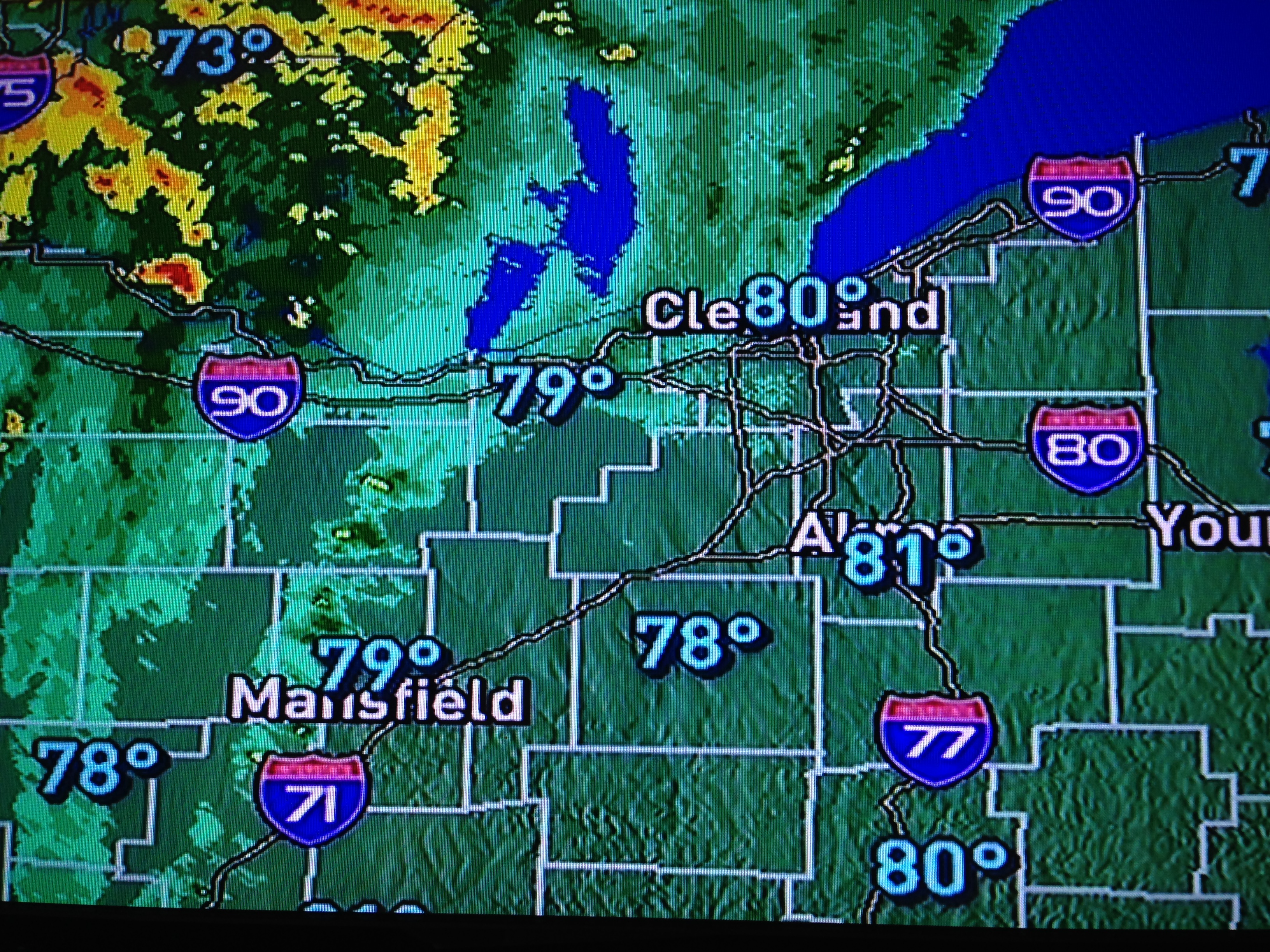
(And if you happen to be in the Cleveland area = 162.550mHz     SAME#039035)

What is a NOAA NWS Weather radio?

My weather radio? Midland WR-300 with a Midland 18-STR visual strobe alert.

Why am I talking about weather radios?

IMG_7484

Be safe…because this is about to hit us here in NE Ohio.

IMG_7485

Woof!

@rusnivek

Precise Emergency Messaging Safety-PIO-SM-14-002

14-002: Precise Emergency Messaging
Agency: Indianapolis Motor Speedway Topic(s):         Emergency Messaging
Date: Summer 2014 Platform:        General

Mass notification and public messaging about dangerous inbound weather is the latest hot button topic in emergency management because no matter the location, everyone is susceptible. This year has been especially deadly with numerous tornadoes.

You can argue the use of automatic Emergency Alert System (EAS), Integrated Public Alert & Warning System’s (iPAWS) messages, and public address systems are good enough, but successful delivery still comes down to basic messaging.

On May 25, 2014, this message was put up on the main billboard on the field during the Indianapolis 500, which had 300,000+ fans during race time. The National Weather Service (NWS) declared a Tornado Warning before the start of the race.

5

Race Fans? C’mon, you have a captive audience at the motor speedway. And you are addressing everyone there, not just race fans. Most likely, your audience is saying “Great, now what is a Tornado Warning?

Clear and concise messaging is incredibly important because seconds will matter in an immediate evacuation or leading others to shelter…especially with large, open, and unprotected public venues. This particular message was unclear, poorly worded, and definitely not concise.

A more effective messaging and follow-up post should have read:

DANGER! TORNADO WARNING NOW – SEEK SHELTER IMMEDIATELY!

Safe SHELTERS are located at AREA X and GATE X

By phrasing it this way:

1. Your message is short, sweet, and to the point.

2. Capital letters will grab the attention of your audience and convey urgency.

3. Have clearly identified safe locations IN CAPITAL LETTERS will assist those reading your message.

4. Shorter messaging could allow your followers to retweet/repost and amplify your emergency messaging.

5. It is still tornado season so make sure you are prepared by having pre-scripted messages on “what is a tornado warning” and messaging on how to “shelter-in-place”.


All concurrent Tweets, Facebook posts, Instagram posts, etc. should reflect this messaging. If a Tornado warning is issued, timing is of the essence. Do not be lax when it comes to emergency messaging because you don’t want to ruin the fun. For the sake of your constituents, it is better to error on the side of safety.

Time is valuable, so post good stuff.

@rusnivek


***To download this as a single-page printable format, click this: Safety-PIO-SM-14-001

Structure vs Ambo – as usual, structure won #EMS

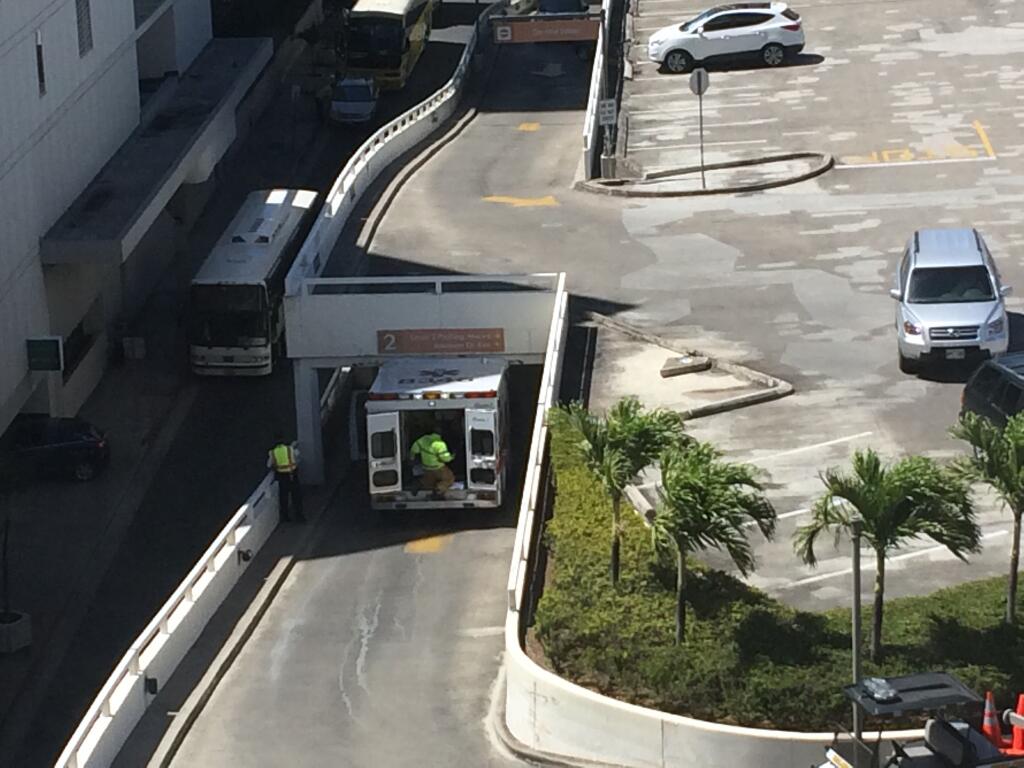
City & County of Honolulu: Ambulance accident w/ patient on 07-12-14.

Here’s the initial picture from the incident.

BsXt7DZCYAE0Qjv

Court of FAKE808SPORTS

Few things to review:

1. Good reminder to check your “Maximum height is ****” plate on your rig.
2. Law enforcement officials should really know the area, including height clearances.

3. Even if Police are leading you out, Fire/EMS should always be aware of your surroundings.

4. Social media is fast and information pertaining to your ongoing situations will always be faster than a PIO.

5. I can already see it now: “Dear Chief, I don’t know what happened…”

6. Crews should have their seatbelts on at all times while the vehicle is moving.


BsXwF6zCcAAc-Ia

Court of FAKE808SPORTS

Thoughts and prayers to the initial victim of the first emergency call.

I hope the leadership in Honolulu figure out the issues at hand. Emergency Service Professionals need some rest.

@rusnivek